Why AI Recommends Your Competitor Instead of You: 6 Signals Answer Engines Trust
AI isn't random. Six signals answer engines trust, why your competitor may have more of them, and a quick check for each to close the gap.
Read →More New Zealand businesses now ask an AI tool for a shortlist before they ask a colleague. So we asked too. We put 15 real buyer questions to ChatGPT, Gemini and Perplexity, three rounds each, and logged 122 answers: every agency named, every source cited and every change between rounds.
What came back wasn't a league table. It was a clear picture of how AI engines decide who to recommend, how much those answers move, and why choosing a growth agency still takes data, strategy and some critical thinking.
We wrote each question the way a business owner or marketing manager would type it, then ran it on all three engines from a New Zealand connection, with no chat history to steer the answers.
| Setting | What we did |
|---|---|
| Engines | ChatGPT (web search on), Gemini and Perplexity, in the consumer apps buyers use |
| Dates | 5 to 6 November 2026 |
| Location | New Zealand IP address |
| History | Logged out or temporary chats, so past conversations didn't shape the answers |
| Rounds | Three rounds per question per engine (Gemini's third round covers 2 of 15 questions) |
| Answers logged | 122: 45 from ChatGPT, 45 from Perplexity, 32 from Gemini |
| Recorded | Every business named and its position, every cited source, and the type of each source |
The 15 questions covered five kinds of buyer intent:
| Question type | Example | Questions |
|---|---|---|
| General shortlist | "What's the best growth agency in New Zealand?" | 4 |
| Specific service | "Which New Zealand agency is best for SEO and content marketing together?" | 3 |
| Problem-led | "Our website traffic has dropped since Google's AI Overviews. Which NZ agency can help?" | 4 |
| How to choose | "What should I look for when choosing a growth agency in New Zealand?" | 2 |
| Regional | "Top marketing agencies in Wellington for growing a service business" | 2 |
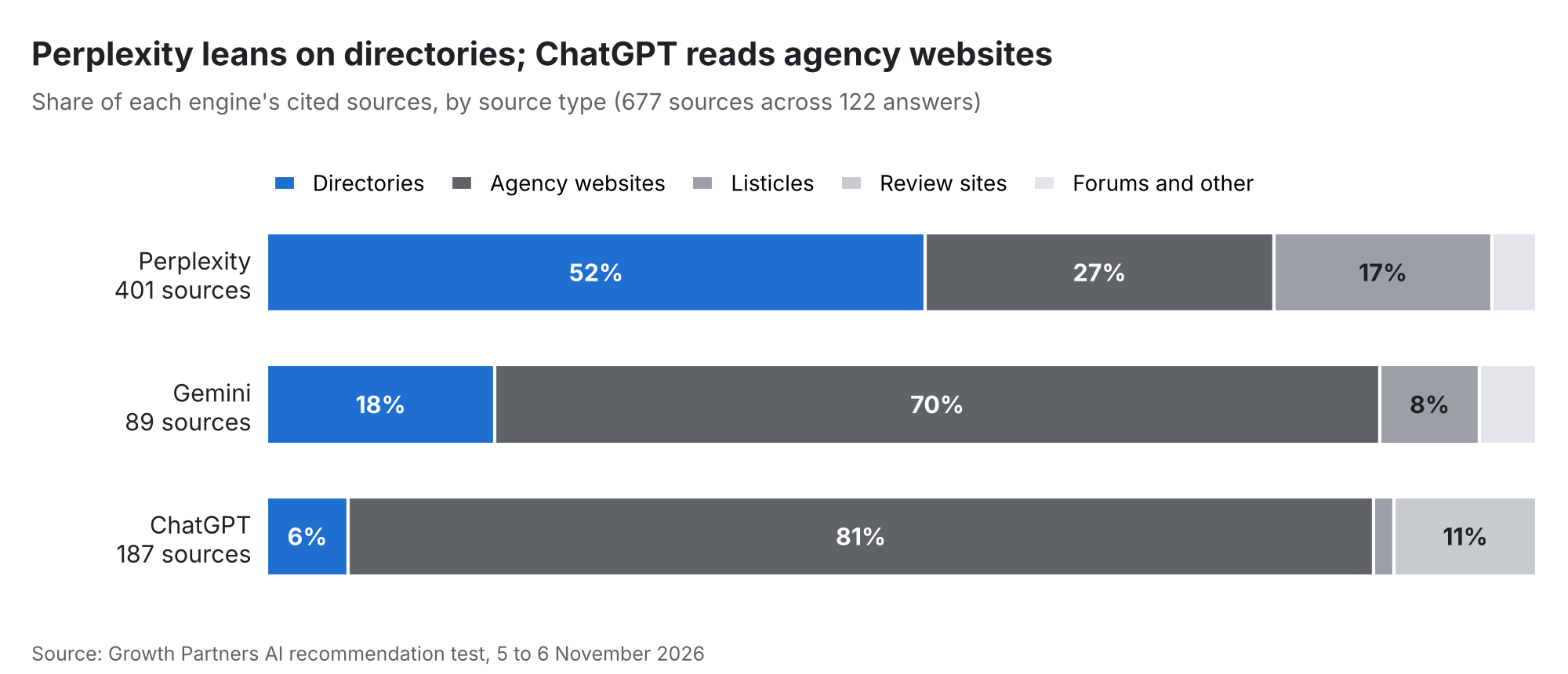
Across all three engines, directories made up 35% of the 677 sources cited. Sortlist alone was cited 84 times, more than any agency's own website. Listicles ("top agencies in NZ" articles) were cited 79 times, and Google reviews 21 times, almost all by ChatGPT.
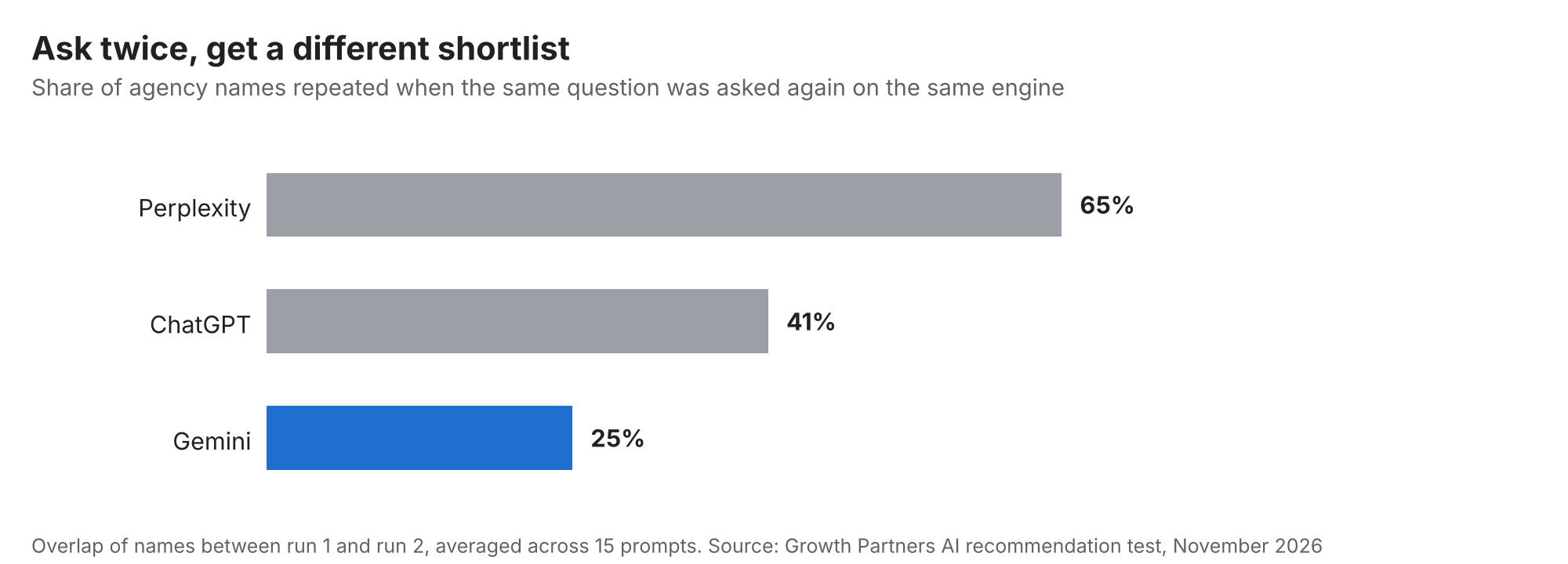
That volatility matters. A single AI answer is one sample, not a ranking. Anyone judging AI visibility from one screenshot, including an agency selling it, is reading noise.
Across 122 answers, the same reasons kept showing up. None of them was "biggest agency" or "biggest ad budget".
We cover each of these signals in depth in Why AI Recommends Your Competitor Instead of You: 6 Signals Answer Engines Trust and Reviews, Directories and Reddit: The Off-Site Signals Quietly Feeding AI Answers.
On the questions about choosing a growth agency, two engines named Growth Partners and described what we do:
| Engine | Question asked | What the engine said about Growth Partners |
|---|---|---|
| Gemini | "Growth agency or digital marketing agency in NZ: which should I hire, and who's good?" | Named first under "Leading Growth & Performance Agencies", for outcome-led strategy, revenue alignment and end-to-end sales funnel growth |
| ChatGPT | "What should I look for when choosing a growth agency in New Zealand?" | Recommended first for AI search visibility, covering traditional and AI search, with transparent indicative pricing |
Both answers were built from our own website. Like most agencies in the test, we weren't named on every question, and the gaps follow the patterns above: directories and third-party lists, which is where our own off-site work is focused now.
Our consumer-app test is a snapshot. DigitalArchitect®, step one of every Growth System, tracks AI visibility on a fixed schedule so results can be compared over time. It runs a saved set of 25 buyer prompts through five AI engines' developer APIs with live web search on: Perplexity, OpenAI, Anthropic's Claude, Google's Gemini and xAI's Grok. That's 125 calls a run. A call counts as a hit if Growth Partners is named in the answer, or if growthpartnersgpx.com appears in the sources cited.
The prompts are generated from the project brief, the 30 highest-volume keywords in our keyword research and facts from onboarding, and mix comparison, use-case, buying-stage, trust and problem-led questions.
| Engine (API) | Model | Hits on our 20 September run |
|---|---|---|
| Perplexity | sonar-pro | 6 of 25 |
| Anthropic | Claude Sonnet 4.6 with web search | 4 of 25 |
| Gemini 2.5 Flash with Search grounding | 4 of 21 (4 calls hit a usage limit) | |
| OpenAI | gpt-5-mini with web search | 3 of 25 |
| xAI | Grok 4 Fast | 0 (all 25 calls failed: the search API was retired) |
| Total | 17 of 125 calls (13.6%) |
The headline score was 13.6%. Reading it properly takes three more questions:
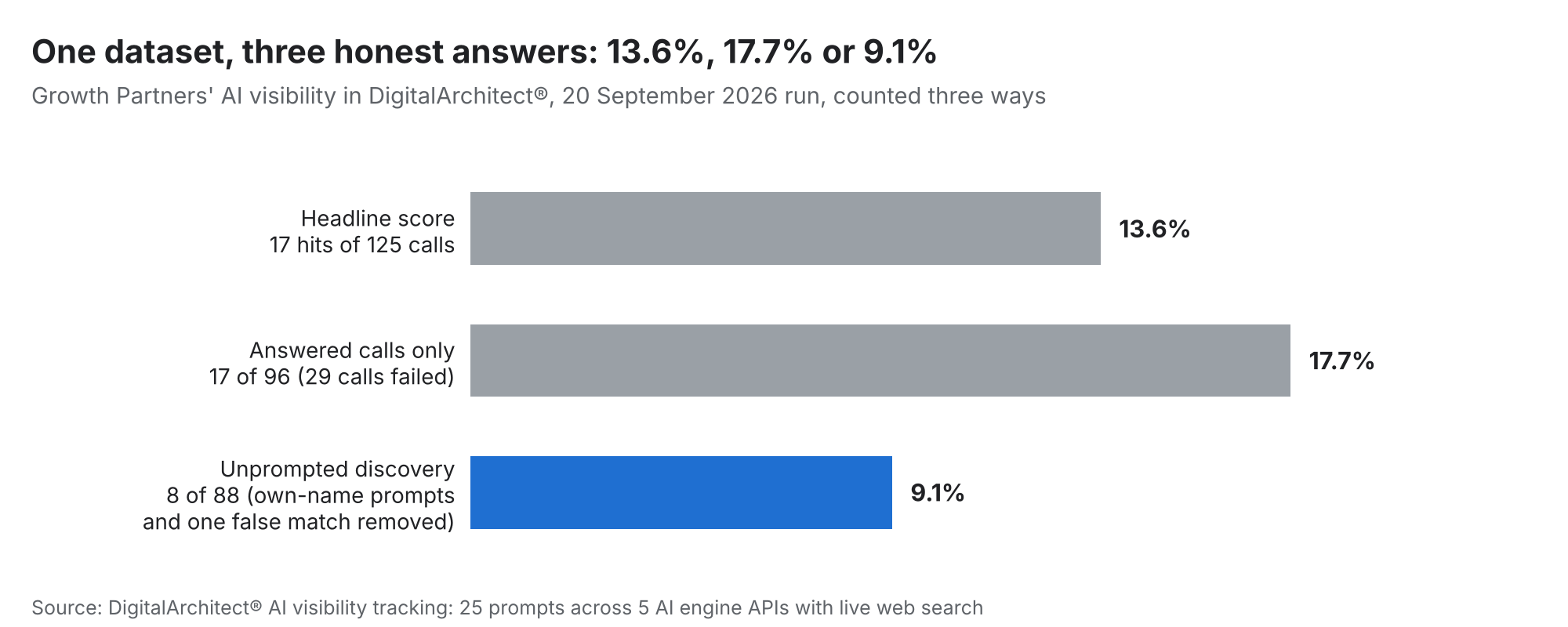
Take all of that out and Growth Partners came up in 8 of 88 answers (9.1%) to prompts that don't mention us, and every one of those answers cited growthpartnersgpx.com. That's our closest measure of unprompted discovery: when a prospect asks something like "best digital growth agency in New Zealand", Growth Partners comes up in roughly 1 in 11 AI answers today.
The same data supports 9.1%, 13.6% or 17.7%, depending on how it's counted. All three are true. Only one answers the question a business owner cares about. That's why we show the working.
An AI shortlist is a reasonable place to start. It isn't a verdict: engines rank what they can find and verify, not who will do the best work for your business. The same thinking that makes good search strategy makes a good agency choice: look at the evidence, ask how it was counted, and connect it to revenue.
| What to look for | Why it matters | How Growth Partners does it |
|---|---|---|
| Evidence before a plan | Strategy built on assumptions repeats them | DigitalArchitect® is step one of every Growth System: market, competitor and AI search data before any recommendation |
| Search treated as one system | AI answers draw on your site, directories, reviews and content at once | Our full search stack covers SEO, AEO, GEO and AIO together, run by one search team |
| Honest measurement | A visibility score depends on what's counted | We separate prompted from unprompted mentions, failed calls from misses, and check matches by hand |
| Proof buyers and AI can cite | Named results get repeated; vague claims don't | Storyhouse, our creative team, produces the case studies, video and content that give buyers something to quote |
| A link to revenue | Rankings and mentions only matter if they turn into customers | The Growth System connects marketing, search and the sales process to revenue |
Before you sign with anyone, ask them the questions this test raised. Which sources does AI cite in my category? How often does my business come up when nobody types my name? How do you count it? A good growth agency will answer with data, and show its working.
AI answers are one more place your buyers look, alongside Google, directories, reviews and referrals. Our search team works across the full search stack, so the evidence on your website and the signals off it are built together.
There's no single answer. Across 122 answers, three AI engines named 160 different agencies, and their lists changed between rounds. Treat an AI shortlist as a starting point and check the evidence behind each name.
With web search on, ChatGPT built its agency answers mostly from businesses' own websites (81% of its citations in our test), plus Google review data. Businesses with a page that closely matched the question were named first.
It depends on the engine. Perplexity relied on directories such as Sortlist, Semrush Agencies and Clutch for about half its citations. ChatGPT relied on agency websites. Gemini mixed the two and often cited no source.
No. Asked the same question again, Perplexity repeated about 65% of its names, ChatGPT 41% and Gemini 25%. Track AI visibility over time rather than judging from one answer.
Use a fixed set of buyer questions, run them regularly across several engines, and separate questions that name your business from ones that don't. Count failed calls separately and check each match by hand.
We'll show you how often AI engines recommend your business when buyers don't type your name, which sources they rely on in your market, and where to focus first.
Book a strategy callTrusted by teams at
Growth Partners clients include SiteMinder, MEX Engineering, Impact HR, SmartShelters, Hot Spring Spas, HR Profiling Solutions, Little Hotelier, Unistor, Storepro, Maple, GymQuip, Power Star Nutrition.